
Open Mind: seven outside the box research ideas awarded
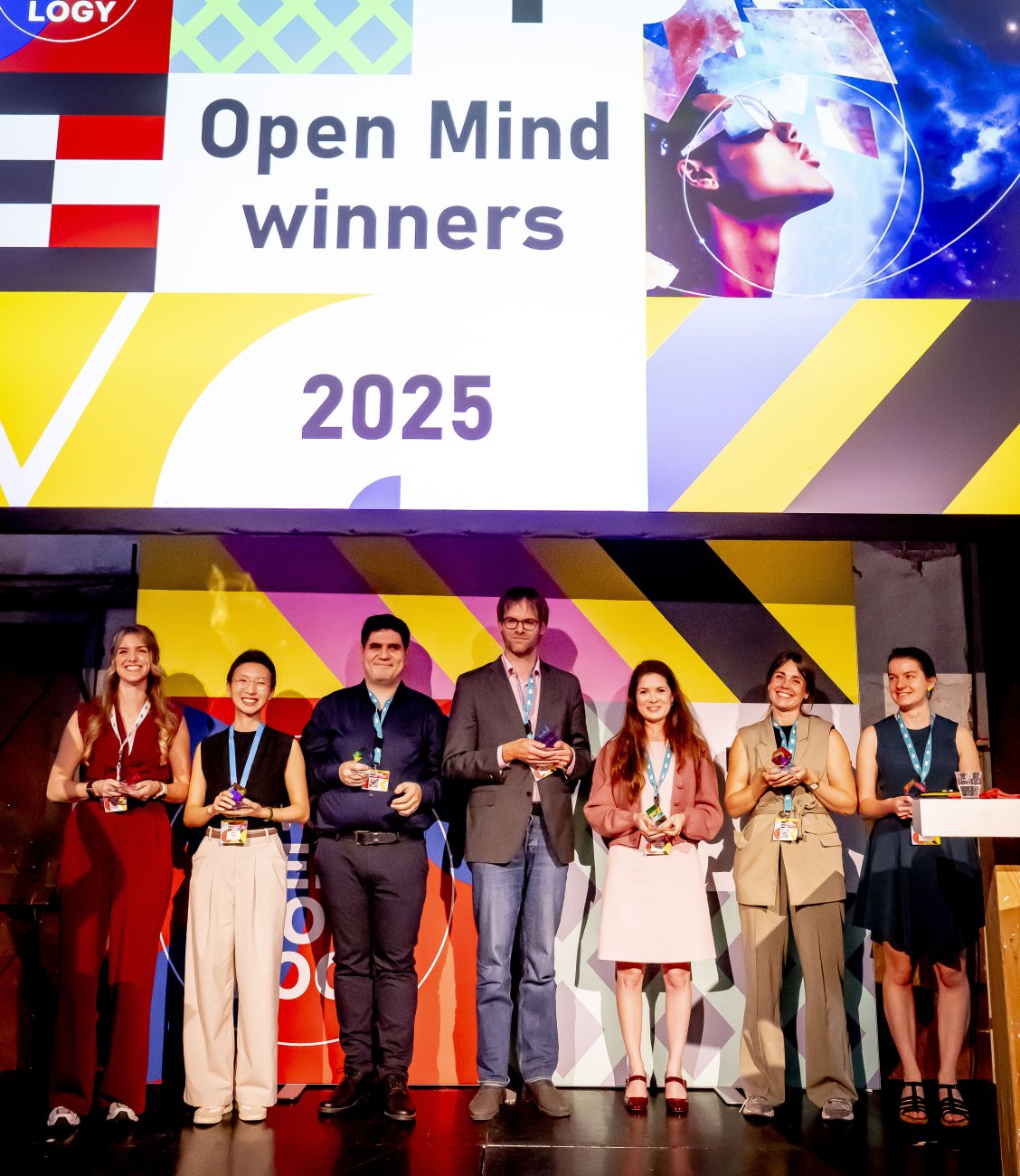
Seven research ideas have been awarded a €50,000 Open Mind grant during the annual NWO innovation festival TEKNOWLOGY. With the Open Mind programme, NWO funds innovative and outside the box research ideas with global societal impact through technology.
Fifteen finalists were selected from all the applications submitted for this round and were given the opportunity to pitch their research ideas to a committee during TEKNOWLOGY. Of these fifteen, seven finalists received a grant that will enable them to work on their research ideas for a year. These “high risk, high gain” research projects carry a high level of risk, but at the same time have the potential to be groundbreaking. Precisely because of their high-risk nature, it can be difficult for researchers to find funding for their ideas. The Open Mind programme therefore offers researchers the opportunity to think outside the box and further explore their ideas.
Open Mind is celebrating its 10th anniversary this year and is entering a new phase. There is a refreshed call text, a new call image and revised objectives and assessment criteria. The impact and originality of the research proposals will now be even more prominent. The committee therefore assessed the finalists during TEKNOWLOGY on these new criteria. This year, the committee was chaired by Mariëtte van Huijstee.
Open Mind winners 2025
Tiny Hearts, Big Impact - A novel electrophysiological approach to detect cancer therapy-induced arrhythmia
Y. Appels - Erasmus MC
12% of cancer-treated patients develop cardiac beating irregularities (cardiac arrhythmia) within the first 6 months of chemotherapy, which poses a risk for life-threatening stroke, heart failure, or cardiac arrest. Yet, the exact mechanisms driving these complications remain unclear. To bridge this gap, we combine cutting-edge electrophysiology with advanced cardio-oncology models to detect and understand arrhythmic events upon anti-cancer treatment. We will adopt and miniaturise techniques frequently used by cardiologists to be suited to identify local cardiac electrical signal conduction heterogeneities in experimental models. With this, the proposed research will create a framework to predict, prevent, and personalise cardio-oncological patient care.
Watch the video about this project
Changing a diagnostic test for Tuberculosis infection into a cheap blood test for Parkinson’s disease
Prof. dr. G. van den Bogaart – University of Groningen
Imagine detecting Parkinson’s disease early, before symptoms like tremors and stiffness appear and irreversible brain damage occurs. Parkinson’s disease is the fastest-growing neurological disorder, affecting millions worldwide. Early diagnosis remains a challenge, yet it is crucial for effective treatment. Our project aims to revolutionize early Parkinson’s diagnosis by adapting a proven test used for infectious diseases. Testing blood samples from Parkinson’s patients and control individuals will help us identify effective protein fragments and assess this test’s diagnostic potential. Early diagnosis could transform care, enabling timely treatment, slowing disease progression, reducing costs, and improving quality of life for patients and families.
Watch the video about this project
Surgery Without Scalpels: Self-Guiding Surgical Tools Using Smart Materials
Prof. dr. ir. J.L. Legrand – Eindhoven University of Technology
What if surgery no longer required cutting? What if flexible instruments, once difficult for surgeons to manipulate, could adapt and move autonomously, finding their own way through the body’s natural openings? With flexible, soft, responsive materials, we can create surgical tools that intuitively navigate the body, sensing organs and structures in real time. These tools can adjust their path and reach the surgical site through natural orifices without the need for an incision. Self-guiding surgical tools enable truly non-invasive procedures, potentially improving around 560,000 surgeries per year in the Netherlands and making previously impossible procedures feasible.
Watch the video about this project
From Poop to Battery
Dr. R. Linssen MSc – Wageningen University & Research
Imagine that, a bio-battery using poop as source! Instead of mining rare minerals, we can upcycle this abundantly present waste source. Some critical questions remain: which microbial sludges show redox activity, which redox active compounds can they make, what are their redox properties, and what kind of downstream processing is needed to make a biobattery from municipal waste? In From Poop to Biobattery we delve into these questions for a more sustainable future.
Watch the video about this project
Plasma-Activated Hydrogels: A Revolutionary Solution for Antimicrobial Resistance in Dermatology
Dr. S. Mirpour - Eindhoven University of Technology
Antimicrobial resistance (AMR) is a silent pandemic that claims 1.27 million lives annually, with dermatological infections being a significant contributor. Almost 70% of pathogenic bacteria are resistant to at least one antibiotic. Current solutions, such as prolonged antibiotic therapies, are not only losing effectiveness but also exacerbate resistance and lead to systemic side effects. We have a solution!: Plasma-activated hydrogels, an antibiotic-free approach to combat this crisis. By utilizing plasma-generated reactive oxygen and nitrogen species, these hydrogels can eliminate resistant pathogens, disrupt biofilms, and accelerate skin healing—all at a fraction of the cost of traditional therapies.
Watch the video about this project
Clearing the view on the brain waste system with multiple viewpoint MRI
E.C. van der Voort - UMC Utrecht
Dysfunction of the waste removal process of the brain is linked to neurodegenerative diseases such as dementia. Currently, incomplete understanding of underlying physiological processes involved in dementia hampers effective diagnosis and treatment. Combining multiple MRI techniques, both inside and outside the brain, we can determine to which extent there is exchange between brain tissue and surrounding cerebrospinal fluid during the cardiac cycle. If successful, it will provide insights into the role of cerebrospinal fluid in waste clearance and help assess the efficiency of removal of waste in dementia patients.
Watch the video about this project
Concrete Origami: Folding the Future
Dr. W. Zhou – Delft University of Technology
What if concrete could fold? Picture this: concrete emergency shelters or temporary bridges unfolding in minutes, offering unparalleled strength compared to tents and far greater durability than traditional temporary housing. When their purpose is served, they simply fold flat, ready to be transported and reused. This project introduces Concrete Origami, a revolutionary approach to foldable, adaptive concrete structures. We integrate thin, prefabricated high-performance concrete panels with innovative origami designs, allowing structures to be compactly stored, rapidly deployed, and dynamically reconfigured. Challenging traditional norms, this project merges cutting-edge material design with pioneering structural forms, unveiling an unprecedented innovation in concrete construction.