About Open Mind
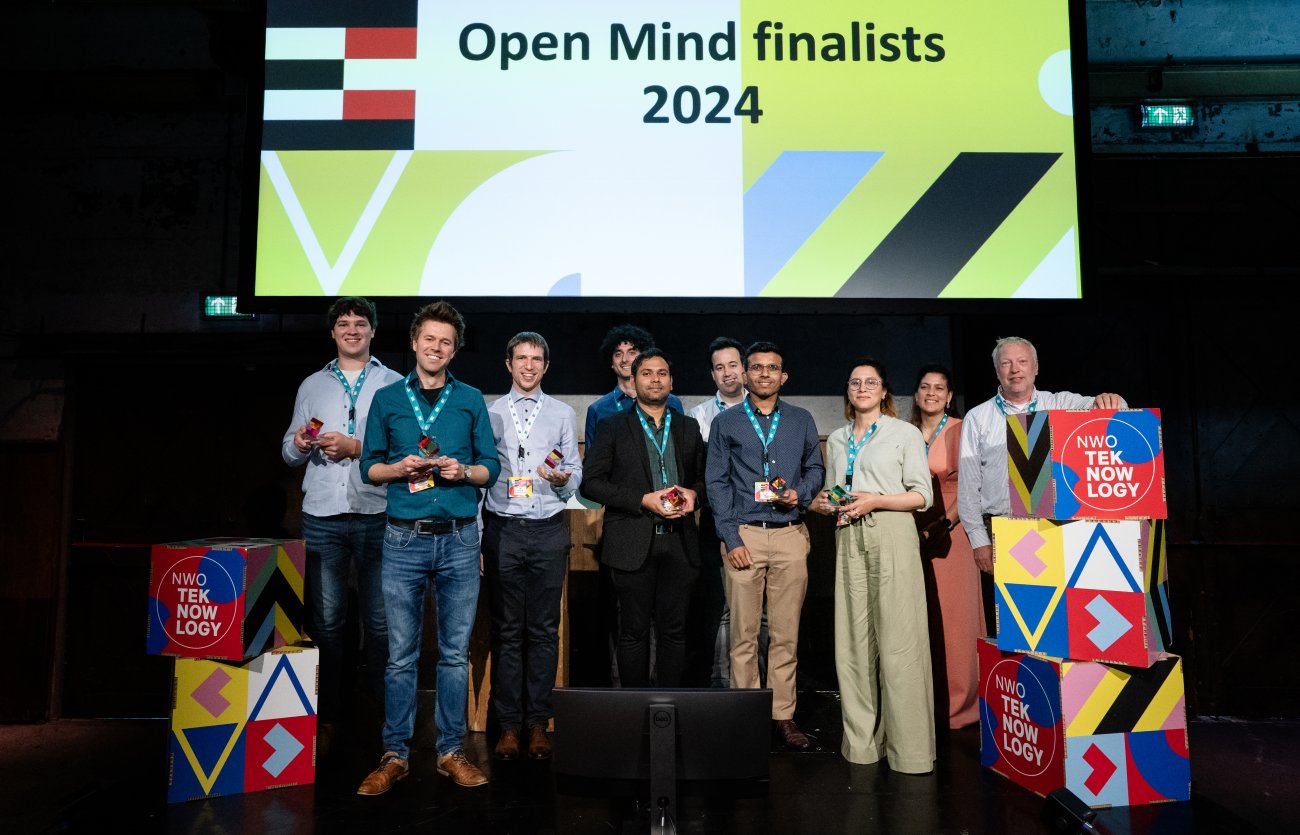
Every year, NWO awards a number of €50,000 Open Mind grants for socially relevant research. Unusual research ideas that contribute to creative and sustainable solutions to societal challenges are sought. This year, 15 proposals were selected for the final, which was presented live during TEKNOWLOGY. In a short pitch, participants explained their out-of-the-box research idea. The seven winners of the competition were selected by a committee chaired by Prof Gert-Jan Gruter.
Open Mind-winnaars 2024
Personalized cardiac fortune telling through virtual time-travel
Tim de Coster, LUMC
To meet the urgent need for better and faster arrythmia outcom prediction, I propose a radical new approach to applying SINDy, a "scientific machine learning” technique, to create simplified cardiac models containing one single measured variable to speed up computation and push them beyond real-time.
Yuval Mulla, Vrije Universiteit Amsterdam
Antibiotics are increasingly failing us due to the rise of antibiotic resistant bacteria (superbugs). Bacteria killing viruses (phages) are a promising alternative. We propose to build a robotic phage isolation platform, and as a proof-of-concept we will use sewage, which naturally teems with pathogenic bacteria and their phages.
Beyond the pixel: Intestinal MRI using neutral implicit representations
Maarten Terpstra, UMC Utrecht
Recent advances in MRI have shown great promise but remain insufficient to make the fine intestinal structures visible. Similar to how Kepler captured the celestial bodies in simple equations, we can use (neural) implicit representations to visualize the smallest structures and motions of the intestine in great detail. onnecting implicit representation to MRI enables imaging at unprecedented resolution and motion robustness needed to diagnose gastrointestinal diseases.
Widefield Diffuse Reflectance Spectroscopy for skin cancer detection & monitoring
Mitra Almasian & Xavier Attendu, Amsterdam UMC
We propose the extension of DRS to a projector and camera system that allows simultaneous, non-contact reflectance measurements across a larger area. To perform this imaging implementation of DRS, we utilize a technique derived from telecommunication applications called code-division multiplexing.
Fish-inspired flow sensors for safer intravenous (IV) infusion therapy
Ajay Kottapalli, University of Groningen
Through this project, we propose to use bioinspired flow sensors in intravenous infusion monitoring by developing them into a medical device that integrates in-line into an IV tube ('works-like' prototype).
Sander Kooijmans, UMC Utrecht
Therapeutic RNA molecules can theoretically be used to treat incurable diseases. Unfortunately, it remains a formidable challenge to deliver such RNA to the right place in the body. I aim to overcome this challenge by loading therapeutic RNA in tiny vesicles that are naturally secreted by all cells in our body.
Sparking the next generation of pressure-gain combustion engines
Ravi Patel & Jeroen van Oijen, TU Eindhoven
This project aims to investigate a novel ignition method for revolutionairy pressure-gain combustion (PGC) engines. We propose an innovative approach involving pulsed plasma-assisted multipoint ignitors which can generate a significantly larger ignition volume at an order of magnitude faster rate.