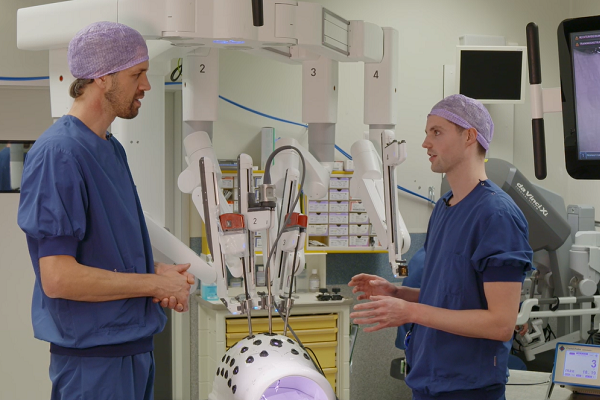
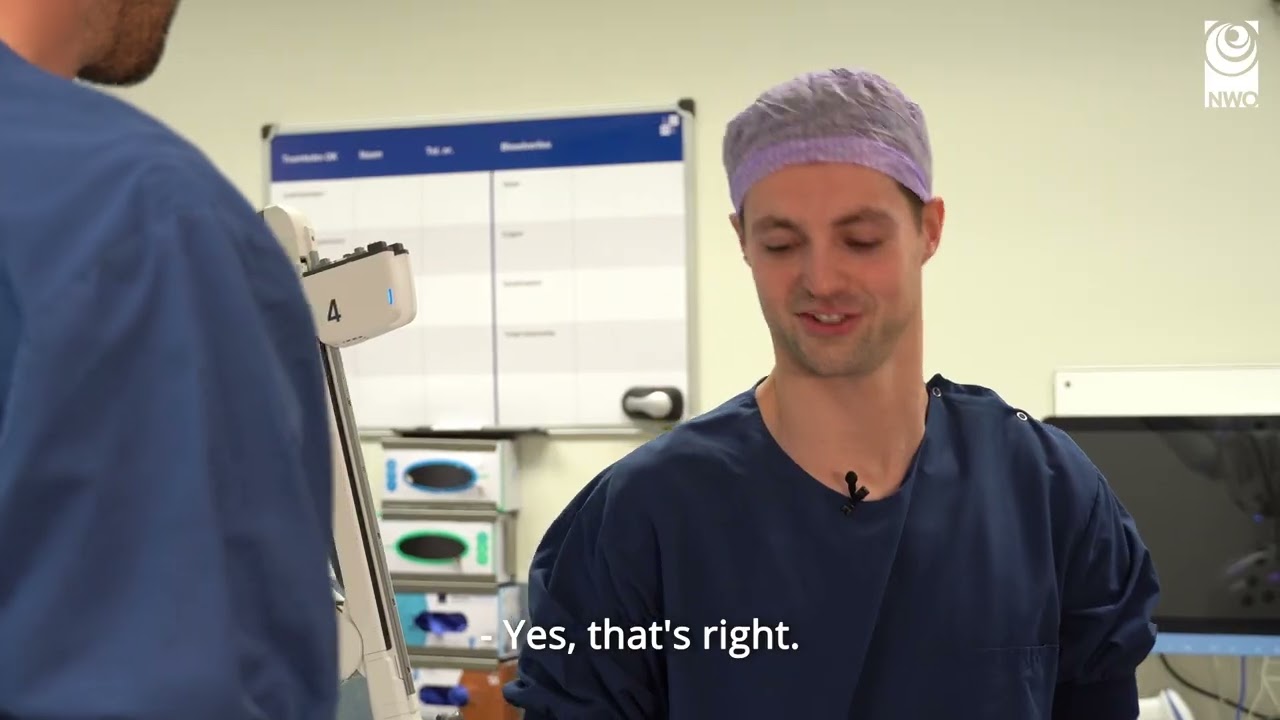
Radioguided surgery is widely used to locate tumours or lymph nodes where cancer may have spread. This allows the surgeon to precisely remove the affected tissue without cutting too much. To detect such a tumour, the patient is administered a radioactive substance that attaches itself to the cancerous cells. The surgeon then searches the abdominal cavity with a radioactive search substance. For a long time, this was done with a long stick that was inserted into the abdominal cavity, but these are rather rigid and do not allow much freedom of movement.
Matthias van Oosterom came up with a solution: as a postdoc researcher in Prof. Fijs van Leeuwen's VICI project, he developed the DROP-IN gammaprobe. Instead of the stick, a small cylindrical device is now inserted, which is attached to a cable. A surgical robot (in this case the Da Vinci Robot) can pick up the gammaprobe and move it around in the abdominal cavity. The gamma probe makes it easier to find tumour tissue and makes operations much less invasive.
The DROP-IN Gamma Probe was received with such enthusiasm by surgeons that it has now been CE marked by two companies and sold in the European market.
Want to know more? During TEKNOWLOGY on 31 May 2022 you can find Matthias van Oosterom at the innovation market to learn more about his research and his gammaprobe.